For communications

The most read thing your institution publishes is a person.

Your leader’s ideas, in their voice — with a record of who stood behind every word.

Retorik drafts what your leader publishes, in their own voice, checks it before you read it, and keeps a record of who checked it, who approved it, and what it drew on.

The case

The channel your institution owns, and hardly uses.

Company pages are read less each year; the people who run companies are read more. Every age group now expects the chief executive to be personally visible. Employees trust a leader who communicates in public three to one over one who does not; readers of the financial press, six to one. And nearly half of people cannot name a single chief executive — trust rises seventeen points among those who can name two.

So the institution’s strongest channel is its leader’s voice, and it posts once a quarter: a post takes days and four hands, and every word carries the institution’s name. That is the gap Retorik closes.

Reported, not our measurement: Edelman Trust Barometer 2025 on what people expect of chief executives and on naming them; Brunswick, Connected Leadership on trust among employees and financial readers; reach reports on company pages against executives.

i.
The voice

Their positions, their cadence. Not a house style.

Your leader has spent twenty years saying things worth hearing — in speeches, letters, board papers. Retorik reads that record and drafts from it: their positions, their cadence, including speeches and town halls.

ii.
The speed

Within minutes, a version for every channel.

A link, a rough paragraph, one of their own ideas, a short conversation — and within minutes, a version for every channel, each written to that channel’s rules. Too long for X? It shortens in their voice, not a machine’s.

On point, because it argues what they argue and sounds the way they sound.

iii.
The checks

Before anyone else reads a draft, Retorik has read it first.

Every number is checked against its sources — supported, worked out, or not found. The subjects your leader will not touch are kept out of every draft. And when the version for X quietly drops a qualification the LinkedIn version needed, the watch line says so. Most drafts pass without a word.

iv.
The loop

You check it. They rule on it.

Sharpen this, cut that, not this week — from a phone between meetings. Whose turn it is, is always visible. Nothing goes out until a person chooses to send it.

v.
The record

Who signed off on that? The answer is already written down.

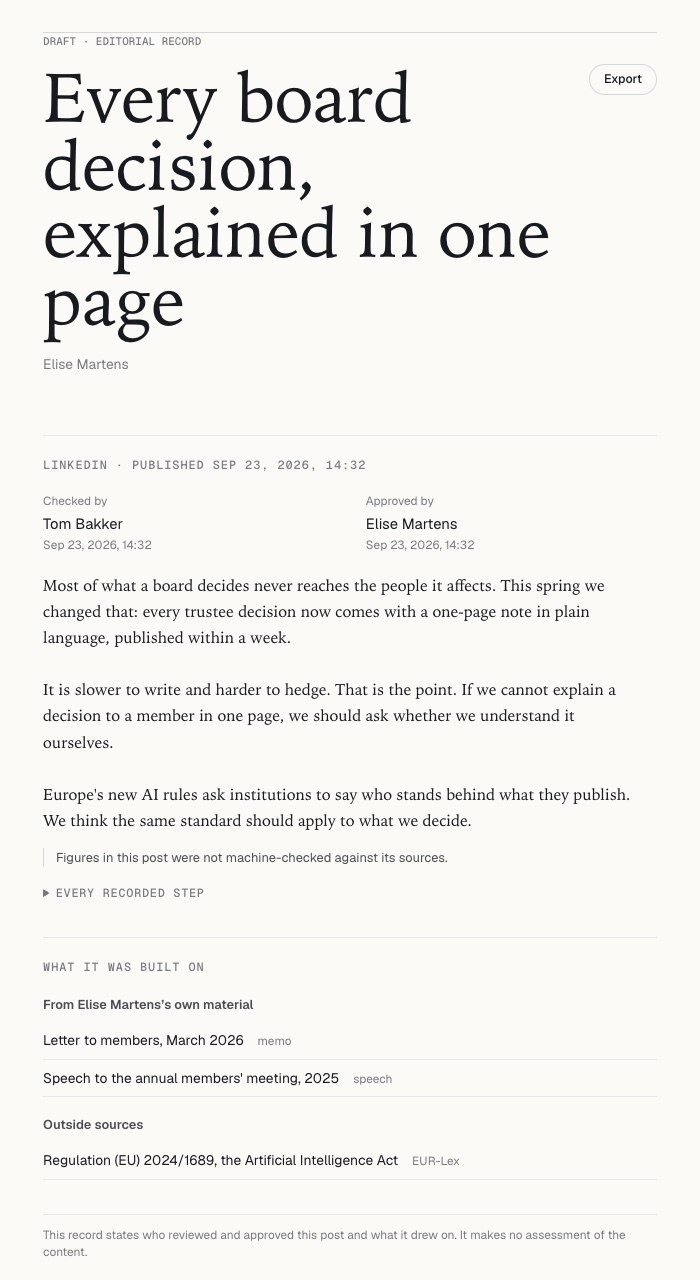
Every published piece carries a page: who checked it, who approved it, and what it drew on — their own past positions and outside sources, by name.

An example editorial record for a LinkedIn post: checked by Tom Bakker, approved by Elise Martens, built on two of her own earlier pieces and the EU AI Act.
Example record, from the product as it runs today. The names are invented.

Since 2 August, the EU AI Act asks the same question. AI-assisted text on matters of public interest must be labelled as such — unless a person reviewed it and a named person holds editorial responsibility. The record is that review, kept as a matter of course. It is evidence of who decided, not a judgement that the decision was right.

vi.
The institution’s own voice

The organisation speaks too.

Its account has its own library, its own learned voice and the same loop. Every word it publishes belongs to a named person, approvable by a second administrator.

Wessel Janse van Rensburg, founder of Retorik
Why I built it

For three years I ran the public writing of one of Europe’s most high-profile CEOs — her posts, her blog, some of her speeches. I know the draft in the document, the reply from the departure lounge, and the question that comes afterwards. Retorik is the tool I wanted then.

— Wessel Janse van Rensburg, founder

Request a call

Most institutions come to Retorik by introduction.

You can also write directly — you’ll hear from me within one working day.

Request a call →     How it works →