The institution speaks in one voice. Yours.

You have opinions.
Only a select few know.

The executive’s voice is the institution’s most underused asset. Most never post. The few who do sound like everyone else — or worse, like a machine.

Retorik drafts what you publish, in your own voice, checks it, and keeps a record of who stood behind every word — with a comms team, or without one.

Who it is for

For the people entitled to speak for an institution, and the people who have to carry it.

Those who run its critical functions and are most empowered to speak in its name. And those whose work is to lead others and bring them along.

  • Chief executives and chairs
  • Chief economists and chief investment officers
  • Rectors and deans
  • Directors-general and secretaries-general
  • Chief medical officers
  • Heads of product and design

And for every form of public and half-public speech they are asked for: the social media post, the op-ed, the speech, the town hall.

Write it yourself, or have it written. Either way, it’s your voice.

You start. A rough paragraph, a few notes on what you want to say. Retorik makes it flow, in your voice, and ties it to what you have argued before. One tap sends it to comms for a check. Their changes come back with a reason each, and you can undo any of them.

Comms start. A draft in your voice, from your own positions, checked by your team before it reaches you. You read, and rule: sharpen this line, cut that claim, not this week. Approve it from your phone, and it goes out with a record of who stood behind it.

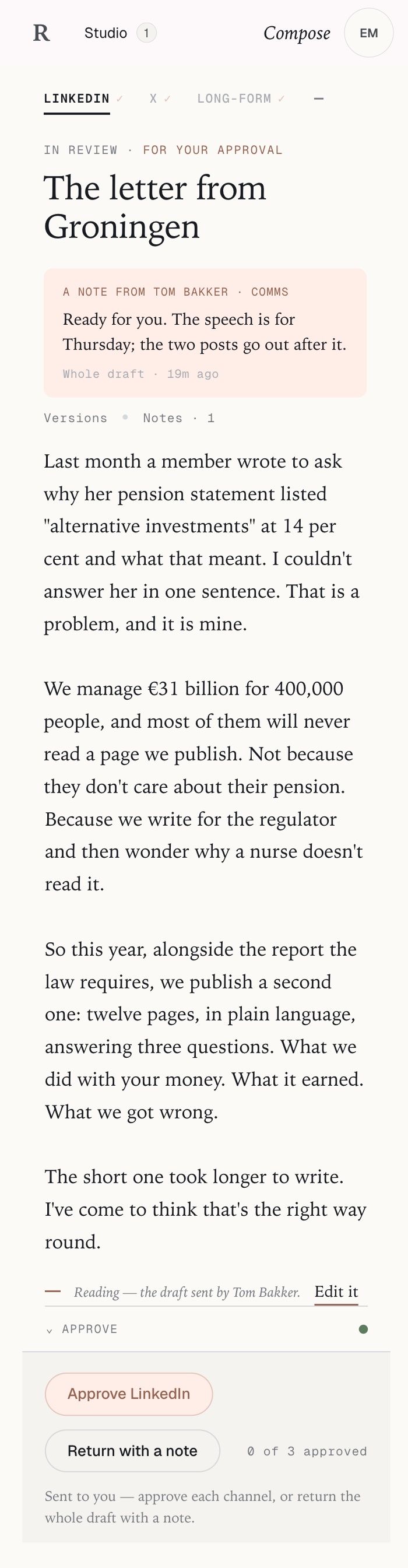
The product as it runs today. The post and the names are an example.

A draft awaiting approval on a phone: a note from the comms team, the post, and the buttons Approve LinkedIn and Return with a note.
i.
The asset

The most valuable view in the institution is the one no one hears.

You have spent two decades forming it. It lives in board minutes, in conference rooms, in speeches heard once, in memos read by nine people. Spoken aloud, it reaches three hundred; in print, a hundred thousand. You post once a quarter — or not at all — because between earnings and the board there is no hour left to draft, route, approve and publish a single paragraph.

ii.
The substitute

And when you do post, it sounds like everyone else. Or worse — like a machine.

The tools meant to help gave every executive the same cadence, the same hedged optimism, the same unmistakable smell of generated text. That is not merely dull — it is a liability. Your name, beneath a sentence you would never have said.

iii.
The friction

It is not that you have nothing to say. It is that saying it takes three days and four hands.

A draft in a document, an email, a reply from a departure lounge — “looks fine, but change the second paragraph” — then silence, a plane, a Friday. The moment that would have carried it has already passed. The voice is yours. The friction is everyone else’s.

The verdict

What if the bottleneck wasn’t the executive
— but the process?

The machine drafts. You steer.

Retorik is for institutions where public words carry consequence: your ideas, in your voice — shaped into a post in minutes, with a record of who stood behind every word.

Why I built Retorik this way →

If you answer for a leader’s public words: For Communications →